What is the IRGC?
The European Union on Thursday classified Iran’s Islamic Revolutionary Guard Corps (IRGC) as a “terrorist organisation”.
Here is what you need to understand about the IRGC:
The IRGC is a segment of Iran’s military, formed following the 1979 Iranian revolution.
Functioning alongside the conventional army, it reports directly to the supreme leader and plays a pivotal role in Iran’s defence, foreign operations, and regional influence.
With approximately 190,000 active members (and over 600,000 when including reserves), the IRGC manages Iran’s ballistic missile and nuclear initiatives and backs proxy groups throughout the Middle East.
It was labelled a foreign “terrorist” organisation by the US in 2019 – representing the first instance in which Washington applied this designation to a component of another government.
In addition to its military functions, the IRGC is intricately woven into Iran’s political and economic frameworks.
US-Iran tensions escalate: What are the objectives of both parties?
By
Robert Mark
and
Julia
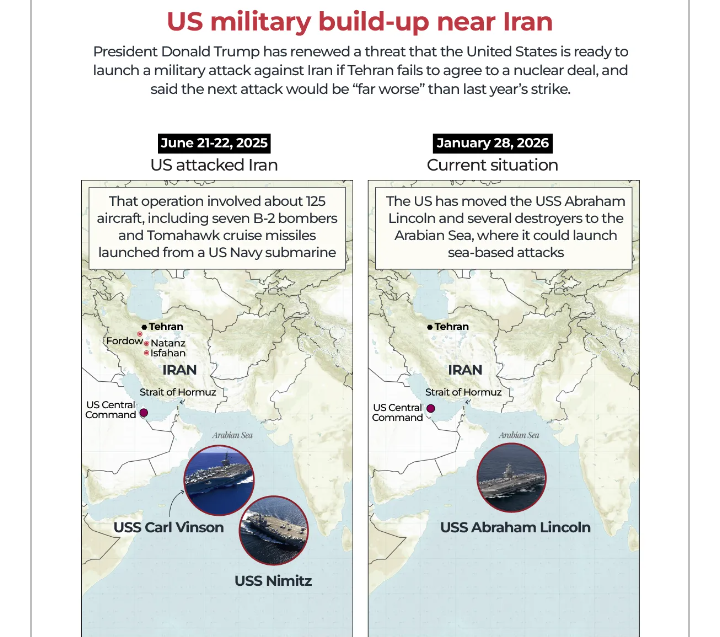
The United States and Iran are increasingly exchanging hostile statements as US naval vessels enter the Arabian Sea, even as regional countries strive for a diplomatic resolution to avert a military confrontation.
This week, US President Donald Trump cautioned that “time is running out” for Iran to engage in discussions aimed at establishing a new agreement regarding its nuclear program.
Trump indicated that the naval forces he was dispatching to the vicinity of Iran were even more substantial than those he had previously sent to the shores of Venezuela, prior to the US special forces’ operation that resulted in the abduction of the Venezuelan president, Nicolas Maduro, during a military action in Caracas on January 3.
US-Iran discussions are still considered a ‘slim possibility’
Academic Roxane Farmanfarmaian notes that Iran has shown its willingness to engage in negotiations, yet remains extremely cautious.
“Iran has persistently advocated for negotiations since the onset of the protests, but they are also apprehensive due to the last round in Muscat being disrupted by Israel’s attacks in June, and Trump has only compounded his acknowledgment of Iran’s pursuit of new negotiations with additional threats,” stated Farmanfarmaian, an affiliated lecturer at the University of Cambridge, in an interview with WSN24.
“Thus, the situation is dynamic, and the Iranians will have specific demands and safeguards they wish to establish before entering into a new round of discussions.
“However, I believe that currently… the likelihood of talks occurring soon is quite slim.”
Iran has issued a warning to promptly target US bases and aircraft carriers should any attack occur, following US President Donald Trump’s statement that time is limited for Tehran to negotiate a nuclear agreement, and the European Union’s decision to designate its Revolutionary Guards as a “terrorist” organization.
Iran’s military spokesperson, Brigadier General Mohammad Akraminia, informed state television that US aircraft carriers possess “significant vulnerabilities” and that many US military assets located in the Gulf region fall “within the range of our medium-range missiles.”
The United States has declared additional sanctions related to Iran
According to an update from the website of the US Treasury Department, new sanctions have been imposed on seven Iranian individuals and one organization.
Among those sanctioned, four individuals are identified as former members of Iran’s Islamic Revolutionary Guard Corps (IRGC).
The United States has already established comprehensive sanctions against Iran. Just yesterday, the US Secretary of State revealed intentions to withdraw immigration benefits for high-ranking Iranian officials and their family members.
If you are just joining us
Here are some of the most recent updates
Turkiye’s Foreign Minister Fidan met with his Iranian counterpart Araghchi in Istanbul, advocating for the revival of nuclear discussions between the United States and Iran.
Fidan also stated that Turkiye is against foreign intervention and will maintain communication with US officials during the ongoing crisis.
Araghchi remarked that Iran is always receptive to negotiations but is not currently intending to engage in talks with US representatives.
A US missile destroyer has arrived at the southern Israeli port of Eilat, as reported by Israeli media, contributing to the increasing military presence of the US in the area.
Iran’s President Pezeshkian has emphasized that his nation is prepared to respond swiftly and decisively to “any aggression.”
Iran expresses readiness to provide assurances regarding its nuclear program, yet remains firm on not negotiating its defense capabilities
By
Ahmed Bin Laden
Reporting from Tehran, Iran
In recent days, Iranian Foreign Minister Abbas Araghchi has engaged in phone discussions with various regional counterparts, including officials from Pakistan, Qatar, the UAE, Saudi Arabia, and Turkiye, where he is currently visiting.
Araghchi has sought to alleviate tensions following the US military buildup in the region. However, his statements echo those made in previous weeks and months.
He asserts that while Iran is open to discussions about its nuclear program and can offer assurances regarding its peaceful intentions, certain matters, particularly those related to missile and defense capabilities that Washington has requested negotiations on, are non-negotiable.
This stance contributes to the ongoing controversy.
Israel has extended an offer to assist Germany in its efforts to pursue Iran’s IRGC
Following the EU’s decision to classify the group as a ‘terrorist’ organization, Israel is prepared to support German and other European security agencies in this endeavor.
A cloud of distrust continues to linger between the United States and Iran
By
Ahmed Bin Laden
Reporting from Tehran, Iran
We are currently facing a critical and precarious juncture in the relations between Iran and the United States. A pervasive atmosphere of distrust looms over the potential for engagement between the two parties.
In June, following five rounds of negotiations that had already taken place, the two nations were anticipated to commence a sixth round.
Subsequently, the Israelis, followed by the Americans, initiated a series of strikes aimed at Iran’s nuclear and military installations, prominent nuclear scientists, and civilian infrastructure.
This historical context adversely affects the current prospects for dialogue between the two sides.