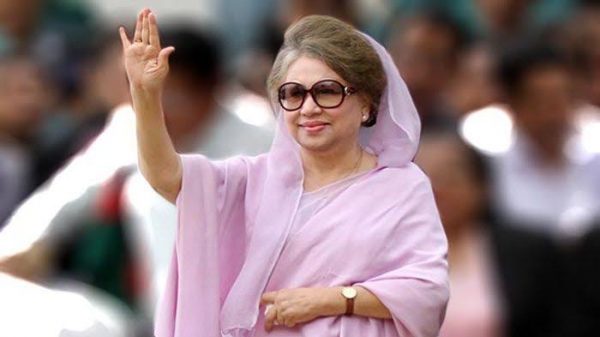
The great woman of Bangladesh, Begum Khaleda Zia, has emerged as a beloved person to the people of Bangladesh. The people of Bangladesh and the whole world are showing so much love for Begum Zia that it is unforgettable. Fascist Hasina and India wanted to kill Begum Zia bit by bit with poison, but by the infinite mercy of Allah, she is still alive. Fascist Hasina and India have been defeated and destroyed, but Khaleda Zia has become the beloved person of Bangladesh and the world. Indeed, there are many secrets of Allah in it that will provide much food for thought for wise people.
Khaleda Zia is a monumental figure in Bangladesh’s political history, notably as the first female Prime Minister of the country and the second in the Muslim world (after Benazir Bhutto). Her political life is defined by her fierce resistance to military rule and her subsequent efforts to establish a democratic and market-oriented state.
1. The Restoration of Parliamentary Democracy (1991)
Her greatest constitutional legacy came early in her first term.
* Democratic Pioneer: After leading a decade-long struggle against the military dictator Hussain Muhammad Ershad (earning her the moniker, the ‘Uncompromising Leader’), her Bangladesh Nationalist Party (BNP) won the 1991 general election.
* The 12th Amendment: Soon after taking office, her government championed the passage of the 12th Constitutional Amendment in 1991. This was a pivotal moment, formally restoring the parliamentary system of government, transferring executive power from the President back to the Prime Minister, and cementing Bangladesh’s democratic framework.
2. Key Economic and Social Achievements
Her governments were instrumental in accelerating the privatization and liberalization of the Bangladeshi economy and making deep social reforms.
| Sector | Major Policy/Achievement | Impact |
| Education | Free and Compulsory Primary Education was introduced. Crucially, free tuition for girls up to Grade 10 and a stipend program were launched, dramatically boosting female enrollment. |
Significantly improved national literacy rates and female empowerment, particularly in rural areas.
| Poverty Reduction | ‘Food for Education’ Program (1993).
Provided food aid to poor families who kept their children in primary school, linking poverty alleviation directly to education.
| Economy | Initiated large-scale industrial privatization and financial reforms (e.g., establishing the Securities and Exchange Commission). Her third term (2001–2006) saw GDP growth surpass 6% for the first time in the country’s history.
| Restored macroeconomic stability, increased foreign direct investment, and expanded the crucial Ready-Made Garment (RMG) sector.
| Infrastructure | Launched the physical construction of the massive Jamuna Multipurpose Bridge (completed later, but initiated during her tenure). | Improved national connectivity and spurred trade between the eastern and western regions.
3. Major Challenges and Controversies
Khaleda Zia’s terms were also characterized by severe political turmoil and significant accusations:
* Political Polarization: Her fierce rivalry with Sheikh Hasina of the Awami League established the deep, often violent, polarization that has defined Bangladeshi politics for three decades.
* Corruption and Law & Order: Her third term (2001–2006) was heavily criticized for a decline in law and order and widespread allegations of corruption within her government and party structures. The corruption cases stemming from this period eventually led to her imprisonment in 2018.
* Militancy: Her last term saw an unprecedented rise in militant activities, including the attacks by JMB, which drew international scrutiny regarding governance and stability.
Khaleda Zia: A Political and Economic Legacy
Khaleda Zia’s political career, particularly her three terms as Prime Minister (1991–1996, 1996 [short-lived], 2001–2006), is defined by a commitment to parliamentary democracy, pro-market economic reforms, and significant focus on education and women’s empowerment.
1. Restoration of Parliamentary Democracy (1991)
Her first, and arguably most important, legacy was leading the shift from a presidential system back to a parliamentary one.
* 12th Constitutional Amendment (1991): Soon after coming to power, her government spearheaded the passage of the 12th Amendment, which formally restored the parliamentary form of government, transferring executive power from the President to the Prime Minister. This established the democratic framework Bangladesh operates within today.
* “Uncompromising Leader”: She earned this reputation for her staunch opposition to the military dictatorship of General Hussain Muhammad Ershad in the 1980s, leading a seven-party alliance and enduring detention seven times to restore multi-party democracy.
2. Major Economic Reforms
Her governments are credited with initiating key liberalizing policies that helped set Bangladesh on the path of steady economic growth.
* Industrial Privatization: She opened the economy to foreign investment and rapid expansion of the private sector, notably in the small and medium enterprises (SME) sub-sector.
* Monetary Liberalization: Her government made the local currency partially convertible and saw the foreign exchange reserve reach a high level at the time.
* GDP Growth: During her third term (2001-2006), the average GDP growth rate remained above 6 percent for the first time in the country’s history. This period also saw a steep rise in export earnings and remittances from expatriate workers.
3. Social & Education Achievements
Her most recognized social reforms were centered on making education accessible, especially for girls in rural areas.
| Policy/Program | Impact |
Free & Compulsory Primary Education |
Introduced nationwide to improve literacy rates.
Free Girls’ Education & Stipends | Made education free for girls up to the 10th grade in rural areas, coupled with a stipend program, which was a landmark step for female enrollment and empowerment.
Food for Education Program (1993) | Provided food aid to poor families who sent their children to primary school, directly addressing poverty as a barrier to education.
| Higher Education | Established the National University and the Open University, and allowed for the establishment of private universities and medical colleges.
The Later Years and Controversies
It is important to note that her later political period and legacy are also marked by significant challenges:
* Controversies: Her third term (2001-2006) was plagued by allegations of high-level corruption and a deterioration of law and order, leading to the controversial anti-crime “Operation Clean Heart.”
* Legal Battles: Since 2017, she has faced multiple corruption convictions, severely restricting her political activities and leading to her extended incarceration and current home detention due to her health.
Khaleda Zia’s Critical Condition and Political Fallout (November 2025)
Former Prime Minister and Bangladesh Nationalist Party (BNP) Chairperson Begum Khaleda Zia is in an “extremely critical” condition, undergoing treatment in the Coronary Care Unit (CCU) of Evercare Hospital in Dhaka. Her hospitalization since November 23rd has thrown a spotlight on the fragility of her health and its profound implications for Bangladesh’s transitional political landscape.
Current Medical Status
The 80-year-old leader was admitted after developing a severe lung infection (pneumonia), which rapidly affected her already compromised heart and kidneys.
* Primary Complications: She is battling multiple chronic ailments, including severe liver cirrhosis, heart disease (she has a permanent pacemaker), kidney dysfunction (requiring regular dialysis), and diabetes.
* Medical Assessment: The medical board supervising her treatment has described her condition as highly complex, noting that treating one illness often adversely affects another.
* Fluid Accumulation: A primary concern is the excessive fluid accumulation in her body, particularly in the lungs, which has caused severe breathing difficulties, necessitating the initiation of regular dialysis.
* Condition Update (Nov 30): BNP Senior Joint Secretary General Ruhul Kabir Rizvi reported on Sunday that her condition remains unchanged—it has not significantly deteriorated, but there has been no major improvement, either.
International Treatment Debate
The medical emergency has reignited the debate over her treatment abroad, a critical political issue since her release from jail in 2020 on a conditional sentence.
* BNP’s Position: The BNP leadership is actively making preparations, including arranging an air ambulance, to take her abroad for advanced treatment (possibly to London or Singapore) as soon as the medical board deems her fit to fly.
* Government Stance: Chief Adviser Muhammad Yunus of the interim government has expressed deep concern for her health, instructing officials to ensure “every form of necessary medical support,” stressing that there should be no “shortcomings” in her care.
Political Significance in a Transition Period
Khaleda Zia’s critical health comes at a sensitive time, with the country under an interim government following the mass protests that ousted the previous administration in August 2024, and with national elections expected in early 2026.
* BNP Morale: The BNP, which has regained political momentum and is widely seen as a frontrunner in the next election, has been plunged into anxiety. The party has postponed its declared nationwide program, the ‘Bijoyer Mashe Bijoy Mashal Road Show,’ scheduled for December.
* Interim Leader’s View: Chief Adviser Muhammad Yunus emphasized the importance of her well-being, stating that “Begum Khaleda Zia is a profound source of inspiration for the nation. Her good health is extremely important for the country.”
* Exiled Son: Her son and the BNP’s acting chairman, Tarique Rahman, who has been living in London since 2008, is in constant communication with the medical team, closely monitoring the situation.
SOURCE: WSN24 AND NEWS AGENCIES