




The youth protest movement opposing Modi’s Hindu majoritarian government has a charismatic student leader
Neha Bora’s cat-and-mouse game with police: Can India’s youth outfox Modi?
From viral images of police detentions to a growing movement over jobs, education and electoral transparency, a young activist has become a symbol of a generation demanding answers from India’s political establishment.
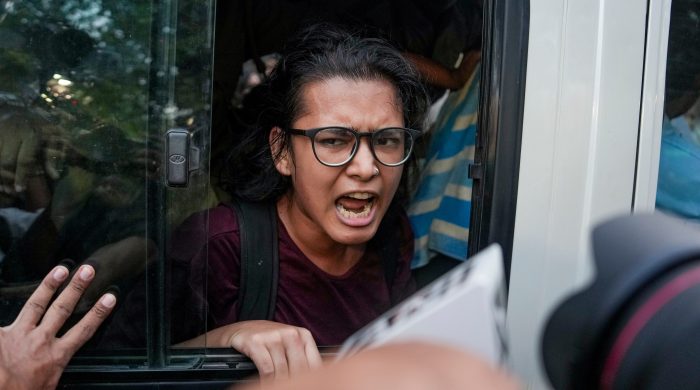
The image is striking: a young protest leader, surrounded by police, yet seemingly unwilling to surrender the street. In the age of viral videos, each confrontation becomes more than a moment of political theatre. It becomes a message — about authority, resistance and the growing distance between a government and some of the young people it claims to represent.
Neha Bora, the national president of the All India Students’ Association (AISA), has emerged as one of the prominent faces of India’s youth-led protest movement challenging Prime Minister Narendra Modi’s government. Repeated detentions, confrontations with police and the circulation of dramatic protest footage have helped propel the doctoral student from student politics into the national spotlight.
In October 2026, reports of a lookalike apparently confusing police during a protest added another layer to the spectacle. Supporters portrayed the episode as evidence that the authorities were struggling to keep pace with a movement increasingly shaped by social media, decentralised mobilisation and youthful defiance.
But the larger question extends beyond one activist’s ability to evade, outmanoeuvre or embarrass the police: can a generation of young Indians turn street-level resistance into a sustained challenge to the political dominance of Modi and his Bharatiya Janata Party (BJP)?
The answer will depend on much more than viral videos.
From the campus to the streets
Bora’s political rise did not happen overnight. Their involvement in student activism dates back years, including the protests against India’s controversial citizenship law in 2019 and 2020. A background in theatre has also shaped their public presence, helping them communicate political arguments in a style that resonates beyond the traditional audiences of organised student politics.
Now, Bora has become associated with a broader wave of youth mobilisation, including protests linked to unemployment, examination-paper leaks and allegations of irregularities in electoral rolls.
The allegations concerning voter registrations have proved especially contentious. Protesters have accused electoral authorities of facilitating the deletion of large numbers of voters in ways that could benefit the ruling party. The Election Commission has denied allegations of wrongdoing.
These competing claims go to the heart of a democratic question: how can citizens trust an electoral system if they believe their names may disappear from the rolls, or if they suspect public institutions are not acting impartially?
Such concerns require evidence, transparent investigations and credible institutional responses. They cannot be settled by slogans alone. Yet the intensity of the demonstrations suggests that, for some young protesters, the dispute has become a symbol of a much broader crisis of confidence.
For Bora and fellow activists, the street offers a platform from which those concerns can be made difficult to ignore.
When detention becomes a political spectacle
In conventional law-enforcement calculations, detention is intended to restrict a person’s movement and restore order. In the era of smartphones and instant communication, however, the political consequences can be less predictable.
A detained activist may disappear temporarily from a protest site but reappear in a video viewed by thousands. Images of confrontations can circulate long after the police operation has ended. A failed attempt to contain a demonstration may become the defining image of the day.
This dynamic has been visible in the coverage of Bora’s protests. Their detentions have drawn attention to both the methods used by authorities and the determination of demonstrators to continue their campaigns.
It is tempting to describe every such encounter as a victory for the activist or a defeat for the state. That interpretation, however, overlooks the complexity of the situation. Police are responsible for maintaining public order, and authorities may impose lawful restrictions on demonstrations. At the same time, the use of preventive detention, restrictions on assembly and the handling of protesters can raise serious questions about civil liberties and proportionality.
The decisive issue is whether restrictions are lawful, necessary and accountable — not simply whether one side manages to outmanoeuvre the other.
For a protest movement, the more significant achievement may be the ability to keep public attention focused on its demands after the cameras have moved elsewhere.
The economic anxiety behind the anger
The rise of youth activism cannot be understood solely through the personalities leading it. Beneath the immediate confrontations lies a set of pressures that have shaped the political expectations of younger Indians.
Employment is central among them. India has experienced substantial economic expansion, but growth does not automatically guarantee secure, well-paid work for everyone entering the labour market. Graduate unemployment, intense competition for government jobs and uncertainty about career prospects have become recurring sources of anxiety.
Education presents another fault line. Allegations of examination irregularities and paper leaks strike at the promise that qualifications and hard work will provide a route to social mobility. For students who spend years preparing for competitive examinations, a compromised recruitment process can mean more than a delayed career: it can undermine confidence in the fairness of the system itself.
These grievances cut across the usual boundaries of political debate. A student worried about a cancelled examination, a graduate struggling to find work and a young citizen concerned about voting rights may not share the same ideology. They may nevertheless share a sense that institutions are failing to meet their expectations.
That is the potential strength of a youth movement — and also its central challenge.
Discontent can bring people into the streets. Building a common political programme out of that discontent is much harder.
Can Modi’s political machinery be outmanoeuvred?
Modi’s political influence rests on more than the authority of the prime minister’s office. The BJP has an extensive organisational network, a powerful communications operation and a record of mobilising supporters across large sections of the electorate. It has also demonstrated an ability to adapt its political messaging to changing circumstances.
A youth-led protest movement operates under different conditions. Its advantages include speed, creativity, digital communication and the ability to attract attention without relying on established party structures. Its weaknesses can include limited organisation, competing priorities and the difficulty of maintaining momentum once the initial excitement fades.
The emergence of the satirical Cockroach Janta Party movement illustrates this unconventional approach to political mobilisation. Its provocative identity has helped draw attention to grievances that might otherwise remain confined to student organisations and opposition-party speeches.
Satire can puncture the aura of political authority. Humour can make dissent accessible to people who might not attend a conventional rally. And a memorable video can travel further than a lengthy policy document.
But making a government look uncomfortable is not the same as changing government policy.
To translate public attention into durable influence, young activists would need to sustain their organisation, document allegations, develop credible policy demands and persuade people beyond their immediate networks. They would also need to demonstrate that their movement can accommodate disagreement without losing its purpose.
For Modi, the challenge is not necessarily one individual who repeatedly appears in protest footage. It is the possibility that separate frustrations — over jobs, education, electoral integrity and freedom of expression — could become connected by a common demand for accountability.
Whether that happens remains uncertain.
The limits of personality-driven resistance
Bora’s growing visibility offers the movement an identifiable face. Yet there is a danger in allowing any one individual to become the entire story.
Movements centred too heavily on a single personality can struggle when that person is detained, faces legal challenges or moves out of the spotlight. Their opponents can also redirect public debate towards the individual rather than the underlying issues.
The more durable form of resistance is one that can function without a single indispensable leader.
That means building networks across universities, professional groups, local communities and civil-society organisations. It means creating reliable ways to verify information, counter misinformation and hold organisers themselves accountable. And it means ensuring that the demands raised at a demonstration are followed by sustained public scrutiny.
There is also a question of political independence. Opposition parties may find common cause with youth activists, particularly when their demands challenge the government. But cooperation can create tensions over leadership, priorities and the use of a movement for electoral purposes.
Young protesters who distrust the established political class may be reluctant to become instruments of any party, including those opposed to the BJP.
Their ability to preserve that independence while achieving practical results could prove as important as their ability to mobilise crowds.
Democracy is bigger than the contest between Modi and Bora
The language of outfoxing Modi makes for a compelling headline. It frames Indian politics as a contest between a powerful prime minister and a younger challenger seeking to expose the limits of state authority.
But democracy cannot be reduced to a personal duel.
India’s political future will be shaped by elections, institutions, economic opportunities, public debate and the ability of citizens to organise peacefully. The government has a responsibility to address legitimate grievances and explain its actions. Protesters, in turn, must substantiate their claims and remain accountable for their own conduct.
Electoral allegations deserve transparent examination rather than automatic acceptance or dismissal. Restrictions on demonstrations deserve scrutiny under the law. Employment and education concerns require policies whose results can be measured, not merely promises made at rallies.
These are questions that cannot be resolved by a clever disguise, a viral photograph or a dramatic confrontation with police.
They require institutions capable of earning public trust.
A generation demanding to be heard
The significance of Neha Bora’s rise may ultimately lie less in whether they can repeatedly frustrate police operations than in what their visibility reveals about political participation among young Indians.
For some, the protests represent a chance to challenge a government they believe has not adequately addressed their concerns. For others, the movement’s allegations and political methods warrant scepticism. Neither perspective removes the need to examine the evidence or understand the conditions that have brought people onto the streets.
The government retains substantial political and organisational resources. The youth movement, meanwhile, has shown an ability to attract attention and connect disparate grievances in the public imagination. What remains unclear is whether that energy can be sustained and translated into institutional change.
The police may be able to detain a protester. A government may be able to restrict a gathering. A movement may even confuse the authorities for a day.
None of those outcomes, by itself, determines the future of a democracy.
The more consequential test is whether young citizens can turn their anger into lasting organisation, their allegations into verifiable evidence and their demands into reforms that outlive a single protest.
Can India’s youth outfox Modi?
The question is not simply whether Neha Bora can stay one step ahead of the police. It is whether a generation can persuade the country’s political institutions to respond to its demands — and whether the movement can maintain its coherence when the cameras are gone.
That contest is still unfolding.
SOURCE : WSN24 AND NEWS AGENCIES

Leave a Reply